
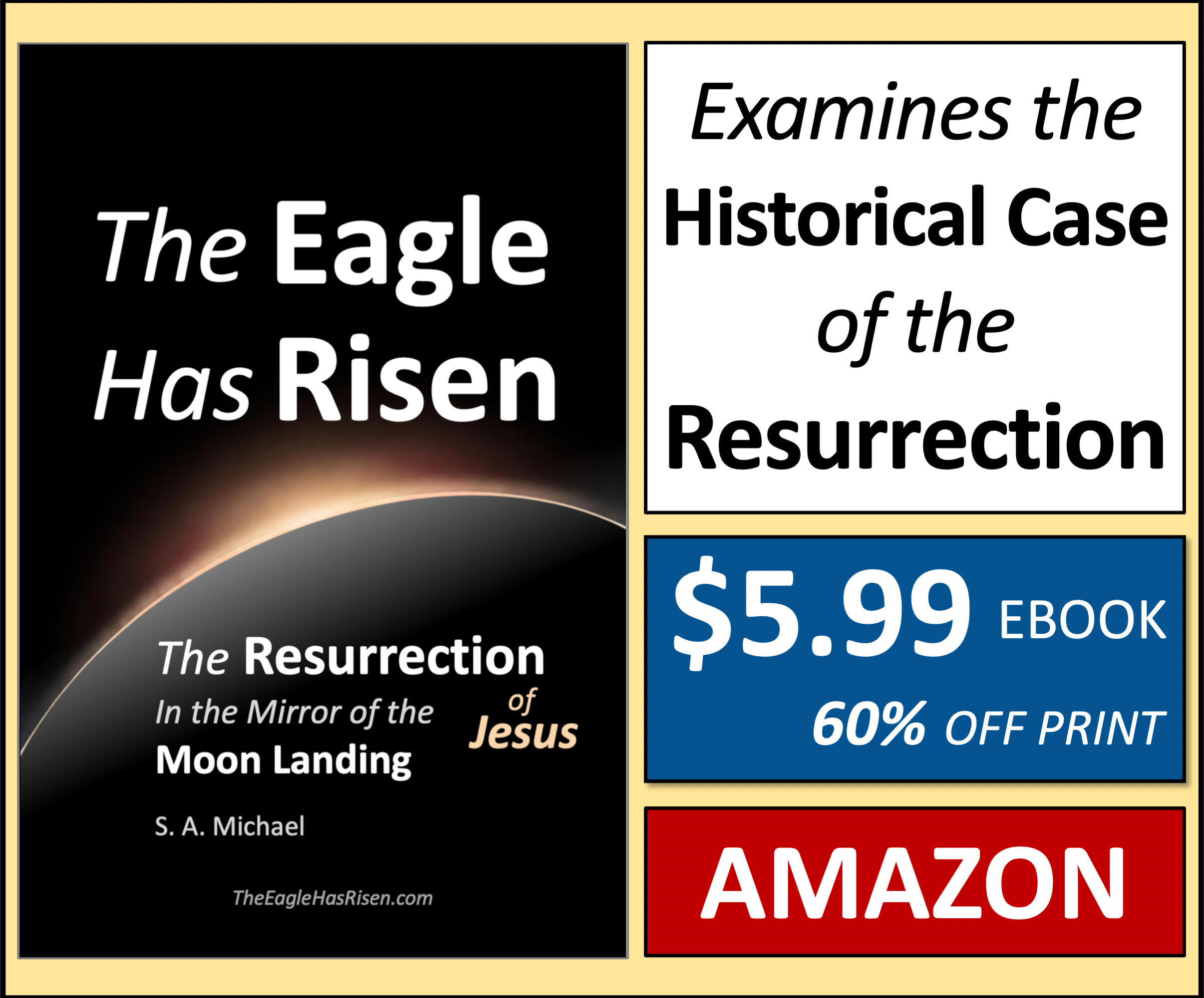
What This Book Explores
We have all heard of amazing events from the past. Stories of heroes, great conquests, and empires. Life and death struggles that mirror the events of modern times. But how do we know any of it actually happened?What about the Apollo Moon landing—an event so astonishing that even some today have a hard time believing it. And yet we still have eyewitnesses with us.But imagine looking back on it from the next century, after the evidence has started to fade.Deepfakes are even more rampant than today. Visual media is deeply distrusted. All who experienced that “one small step” firsthand are long gone. The historical evidence is no longer as pristine.Could we still know that humans walked on the Moon?Of course. But how would we know?We would have to do what historians have always done: examine the surviving evidence, consider its sources, weigh competing explanations, and ask what conclusions the evidence can actually support.Watching the launch of Apollo 11, I never considered that question. Like millions of others, I was in awe as humans began a journey that had previously belonged only to science fiction. The Moon landing helped spark a love of science and shaped the way I would approach problems for the rest of my life.But history also became a lifelong fascination—not as a collection of sterile dates and facts, but as lived experiences. When we view the past through the eyes of those who witnessed it, something closer to the truth can emerge.Eventually, I approached the life, death, and Resurrection of Jesus of Nazareth with this mindset.I thought, “If we can historically investigate one extraordinary event—the Moon landing, then why can’t we look at another, the Resurrection—using that same methodology?”If it happened, the evidence should be capable of supporting it.Not because these events are equivalent. They clearly are not. One occurred in the modern age and was documented extensively; the other occurred two thousand years ago and describes something that, by its very nature, defies ordinary experience.But time is the great equalizer, and the Moon program is already fading into history. Eventually, every extraordinary event—no matter how thoroughly documented—must be examined through the evidence that survives it.So we reach back through decades, centuries, and millennia toward the discovery of the truth of what happened.Just as we might examine the Moon landing from a more distant future, we will use the same historical methods to investigate the Resurrection of Jesus—an event from the more distant past whose effects are still reverberating across time and space and into our world today.
About the Author
S. A. Michael spent his career analyzing complex systems—not ancient history. As a systems architect and engineer, he learned to break down problems, question premises, and reason from evidence rather than presumption.In The Eagle Has Risen, he brings that same mindset to an unexpected comparison—and one of history's most debated questions.


First edition, 2026
Published by Eagle Rising Press
For more information about this book, visit:
© 2026 S. A. Michael. All rights reserved.
The Eagle Has Risen — Preview
The opening pages of The Eagle Has Risen
© 2026 S. A. Michael. All rights reserved.
Preface: How This Investigation BeganI was nine years old when Apollo 11 left the launch pad. Along with millions of others, I watched in awe as human beings accomplished what had previously belonged only to science fiction. It never occurred to me that anyone would one day question whether it had happened. To me, it was more than an inspiring moment. It demonstrated what imagination, disciplined problem-solving, and unyielding focus could achieve.
That moment did more than inspire. It shaped the way I would come to approach problems and instilled a desire to take on challenges that felt larger than life—on the scale of Apollo. That longing planted a seed that would guide my professional life. Again and again, I found that even the most complex problems could be approached in the same way: by breaking them down into smaller parts and continuing that process until each piece could be fully understood and solved. With patience and persistence, very few problems fail to yield.
I have always loved science as a tool for understanding the world around us. And alongside science, another love has been history—not as a collection of sterile dates and facts, but as the lived experience of real people. When history is viewed through the eyes of those who lived it and without preconceptions, something closer to the truth can emerge. This perspective shaped how I came to examine—and ultimately accept—the claim that the death and Resurrection of Jesus of Nazareth were historical.
Yet for me, belief cannot be blind, nor should it excuse me from asking whether the evidence can bear the weight placed upon it. This led me to an unusual comparison: the Resurrection and the Apollo Moon landing. Although this may seem audacious, to me it was a natural progression.
When I began, I assumed the historical evidence for the Moon landing would vastly exceed that for the Resurrection, and that any comparison would quickly collapse.
It did not.
That unexpected result is the reason this book exists.
The opening pages of The Eagle Has Risen.
© 2026 S. A. Michael. All rights reserved.
Part I: FoundationsChapter 1: Two Familiar Phrases
The Moon LandingDays earlier, the three-man crew of Apollo 11—Neil Armstrong, Buzz Aldrin, and Michael Collins—had lifted off aboard the most powerful rocket ever constructed, riding a column of fire into space between the Earth and the Moon.
***
Now it was July 20, 1969.
The lunar module (LM) separated from the command module and began its powered descent, dropping out of orbit toward the landing area in the Sea of Tranquility.Almost immediately, the onboard computer issued a program alarm.“1202.”The landing computer, designed to pilot the craft automatically to a safe touchdown, was signaling that it was being overloaded—it was being asked to do more tasks than it could handle. In Houston, the guidance officer had only a few seconds to determine whether the landing could continue.“Go.”The landing attempt could proceed.A second 1202 alarm followed. Same rapid evaluation. Same decision.“Go.”As the LM passed over the intended landing area, the surface visible through the window did not match the smooth terrain selected in advance. The spacecraft was being carried toward a field of boulders and a crater.Commander Armstrong took manual control, flying the craft forward in search of a level place to land. The remaining time before fuel exhaustion was called out at intervals.“Sixty seconds.”At low altitude, the engine exhaust began to disturb the lunar surface.“Kicking up some dust.”The dust cloud grew thicker as the descent progressed. Surface features became difficult to distinguish. The crew’s training was being tested as the craft was piloted through a moving cloud. At this point, an empty fuel tank would mean failure and death. The countdown to empty continued.“Thirty seconds.”A light on the panel indicated that one of the landing probes had touched the surface.“Contact light.”“Engine stop.”After a brief pause, a transmission came from the lunar surface to Earth:“Houston, Tranquility Base here…”“The Eagle has landed.”The reply from Mission Control followed:“You got a bunch of guys about to turn blue. We’re breathing again.”
***In Houston, the room that had been silent during the final descent began to move again.The signal carrying those words took a little more than a second to cross the distance between the Moon and the Earth. Before any human stepped onto the Moon's surface, a historical claim had already been made. Not simply that a machine had functioned as designed, but that human beings had taken off from Earth, crossed the void between two worlds, descended from lunar orbit, and landed on another celestial body.The event is often reduced to a single image or a sentence, but the claim itself is not a single moment. It is a sequence of dependent elements—guidance, propulsion, navigation, manual control, landing—each one capable of failure, each one open to verification.When we say that human beings landed on the Moon, we are compressing the entire sequence into a single phrase.In reality, even seemingly simple historical claims are made up of an interdependent series of claims. To verify whether an event actually occurred requires that it be broken down into the smaller events upon which it depends.
The opening pages of The Eagle Has Risen.
© 2026 S. A. Michael. All rights reserved.
The ResurrectionThe twentieth chapter of the Gospel of John records an appearance of the resurrected Christ to the apostle Thomas. It reports that Thomas was not present the first time Jesus appeared to the other apostles.The others told him, “We have seen the Lord.”The report was not of an empty tomb alone but of an appearance in which his wounds—from the nails and the spear—were shown.According to the account, Thomas—later called the doubter—responded with:
“Unless I see in his hands the mark of the nails,
and place my finger into the mark of the nails,
and place my hand into his side,
I will not believe.”It is a demand for continuity between the executed body of his Lord and the one now reported as alive. He was refusing to accept secondhand testimony for an event that, if true, would be extraordinary and overturn ordinary experience.
***Eight days later, the account states, the disciples were again inside, and Thomas was with them. The doors were shut. The greeting is the same as before.“Peace be with you.”The attention then turns to Thomas.“Put your finger here, and see my hands; and put out your hand, and place it in my side. Do not disbelieve but believe.”The exact preconditions he had stated for belief are repeated to him.
The Gospel of John next records his simple reply:“My Lord and my God.”The appearance is presented as involving the same individual who had been crucified and identified by those wounds. It is also noted as occurring in the presence of multiple witnesses and following an explicit refusal to believe without direct verification.According to this account, Thomas was now convinced.
The opening pages of The Eagle Has Risen.
© 2026 S. A. Michael. All rights reserved.
***
We began with two familiar phrases: the Moon landing and the Resurrection.Each is commonly spoken as though it were a single moment. Each can be represented by an image. Each is often accepted or dismissed in a moment. But when the sequence behind the phrase is allowed to unfold, what first appeared simple becomes a series of dependent claims.To say human beings landed on the Moon is to affirm far more than the image of a figure descending a ladder. It is to affirm the launch from Earth, the navigation across the distance between two worlds, the insertion into lunar orbit, the separation of the lunar module, the powered descent, the assumption of manual control, and the landing itself.Beyond these, it affirms the ability and the sustained discipline required to construct the machines that crossed the space between the Earth and the Moon, explored another world, and returned across the void. Each either occurred or did not. Each stands in relation to the others. Remove one, and the claim collapses.
Likewise, to say Jesus rose from the dead is to affirm more than a single word. It is to affirm a public execution, a burial, the report of an empty tomb, the claim of appearances, the identification of the crucified body by its wounds, the transmission of those reports to those who were not present, and the response of those who first heard them.It also affirms that those who carried out the execution had reasons for doing so, and that the surrounding people and culture preserved and transmitted the memory of such events.Here as well, the elements form a sequence. Remove one, and what remains is no longer the same.In both cases, a conclusion that is often treated as immediate is in fact the end of a chain.
History does not deal in conclusions, but in claims—made by particular people, at particular moments, under particular circumstances—which are received, repeated, examined, or rejected by others.Before any judgment can be made about a claim's veracity, the claim itself must be allowed to stand in its full form.This requires asking questions: What is being asserted? Who made the assertion? When was it made? Under what circumstances was it received? What would it mean for the claim to be false?These questions do not determine the outcome; they only begin the investigation.For most modern readers, these two claims do not begin at the same place. One is located in the familiar world of engineering, physics, and recorded images and telemetry. The other is often assigned to the category of religion before its sources are even opened.Yet the difference is not, at first, a difference in the structure of the claims themselves, but a difference in how they are classified.If one claim is permitted to enter the realm of historical examination while the other is set aside as a matter of private belief or philosophical impossibility, then the conclusion has been reached before the inquiry has begun, and the truth may be lost.
The question at this stage is not which claim is true, but whether both sets of claims are being approached in the same way.In the following chapters, the sequences behind the Resurrection will be taken up piece by piece—the timing of the reports, the character of the witnesses, the conditions under which the claims were made, the manner in which they were transmitted, the culture that allowed the claims to make sense, and the alternatives that have been proposed.When the claims are allowed to stand in their full form, they can be evaluated, and only then can a judgment be made. But before any conclusion is reached, a more basic decision must be made.Are we willing to ask the same kinds of questions of both?
© 2026 S. A. Michael. All rights reserved.
Chapter 2: How We Will Ask the Question
Two Claimed EventsIn July of 1969, human beings first walked on the Moon.Most of us have never examined the telemetry or mission records, or inspected the spacecraft or handled the lunar samples. Yet nearly all accept the Moon landing—either because we lived it or because we recognize the strength of the evidence. The documentation was produced close to the time of the event, and is public and extensive. There were numerous witnesses, and the claim was made in full view of a watching world—friend and foe alike. It has survived intense scrutiny.Nearly two thousand years earlier, another public claim of an extraordinary event was made in Jerusalem.A man who had been publicly executed was said to be alive again. His tomb, according to early reports, was empty. Afterward, his followers insisted they had seen him—spoken with him, touched him, and eaten with him. They proclaimed this not in distant lands generations later, but in the very city where he had been publicly killed.One event is almost universally accepted—though not without exception. Even the Moon landing, one of the most thoroughly documented events in modern history, has its skeptics.The other is often dismissed before the evidence is even viewed. One is presumed to be supported by evidence, while the other is not. That presumption should itself be tested.
The question is not whether one claim appears more outlandish than the other, but whether one has been judged without examining the evidence.
The ResurrectionLike most events from the ancient world, the claims of the Resurrection come to us through writings—from witnesses, participants, or those who heard from them. Such documents are not set aside because they are written by those involved or reflect a particular viewpoint; they are examined.To consider these accounts is not to assume they are true, but to recognize them as historical claims of the same kind upon which all ancient history depends.
Yet the documents that record the Resurrection do something distinctive: they invite scrutiny.They name places, identify rulers, and situate their claims in history rather than in mythic time. They appeal to eyewitnesses, many of whom were still living when the claims first began to circulate.Still more striking, the earliest Christian writings stake everything on the truth of the Resurrection. They admit that if it did not happen, the movement collapses—and their faith is empty. If so, the witnesses are false and the entire enterprise rests either on illusion or deliberate deception.Many belief systems can survive even when their central claims are never tested against history.Christianity does the opposite: it binds its credibility to a single historical event upon which it stands or falls.Christianity does not ultimately ground itself on a moral code or a philosophy. Its truth instead depends on whether a specific event occurred in actual history. That alone makes the claim worthy of careful consideration.
The WitnessesThe first people to proclaim the Resurrection were eyewitnesses, and they did so publicly and at great personal cost. They gained neither wealth nor power, but instead faced opposition, imprisonment, and death.
If they knew their claims were false, they were not merely mistaken; they were deliberate deceivers who maintained a lie under intense persecution. If they were not deceivers, then something extraordinary must have occurred to convince them that death itself had been reversed. Either way, their behavior and claims demand explanation.It is certainly possible to propose alternatives such as conspiracy, hallucination, legend, or gradual myth—each deserves to be evaluated. But before weighing those possibilities, a more foundational question must be asked:Are we applying the same standards to this claim that we apply elsewhere—or have we already decided the answer in advance?
The FrameworkMost of us readily accept extraordinary technological achievement. Rockets and spacecraft can be engineered. Mathematics can chart trajectories to other planets. Human ingenuity can exceed what earlier generations could have imagined.But the Resurrection makes a different kind of claim: something seemingly impossible occurred—a man was killed, buried, and returned to life.That difference reveals something important: evidence never stands alone, but relies upon a framework of belief—assumptions about what is possible and what is not. If miracles are ruled out in advance, then no testimony will ever be enough. Yet if the possibility remains open, even cautiously, then the evidence must be examined rather than casually dismissed.This book will examine sources, timing, witnesses, objections, and alternatives, and then ask a simple question:If we examine the Resurrection claim by the same historical standards as a similarly extraordinary event—the Apollo Moon landing—what conclusions will we reach?
A Personal ReflectionMy grandfather never believed that men had walked on the Moon. It was simply too incredible to him.It had been a fixture of his life, distant and untouchable. The idea that human beings had stood upon that silent orb felt like fantasy dressed in machinery and scientific mumbo jumbo. And yet he never doubted that a man had risen from the dead in first-century Jerusalem. To him, the Resurrection fit naturally within the world as he understood it, but the Moon landing did not.Today, many reverse that judgment: rockets seem plausible, but resurrections do not. For them, the Moon landing fits comfortably within the universe as they conceive it. An empty tomb does not.The deeper question is not whether evidence exists, as both claims come with evidence.It is what kinds of events we are willing to consider possible within the world we believe we inhabit.
© 2026 S. A. Michael. All rights reserved.
Table of Contents
The Eagle Has Risen — Preview
Table of Contents
ContentsPreface
How This Investigation BeganPART I
Foundations1. Two Familiar Phrases 5
2. How We Will Ask the Question 13
3. The View of a Room 19
4. The Larger Room 27
5. Within Living Memory 29PART II
The Resurrection Claims6. The Crucifixion and the Death of the Dream 37
7. The Empty Tomb 47
8. The Bridge of Apollo 51
9. The Garden Encounter 55
10. The Locked Room 57
11. Thomas Returns 61
12. From Fear to Fire 65PART III
Replication and Distribution13. Fire in the City 73
14. A Man Full of the Spirit 79
15. Heaven Opened 81
16. Saul of Tarsus 85PART IV
Prerequisites and Architecture17. A Critical Message 91
18. Language 97
19. Network 101
20. Mobility 105
21. Writing 109
22. Expectations 113PART V
Calibration23. The Case of the Resurrection 119
24. The Case of the Moon Landing 127
25. Summation and What Remains 135
26. Conclusion: The Final Question 145Afterword 153
How I Answered the QuestionEpilogue 159
The Architectural Requirements of HistoryA Brief Note to the Reader 167
Acknowledgments 169APPENDICESAppendix A 173
Apollo 11 and Historical Evidence
Appendix B 183
Corroboration from Archaeology
Appendix C 187
Two Portraits of the Messiah
Appendix D 195
Resurrection Narrative Sources
Appendix E 199
Sources and ReferencesAbout the Author 203
S. A. MichaelLast Words 205
© 2026 S. A. Michael. All rights reserved.